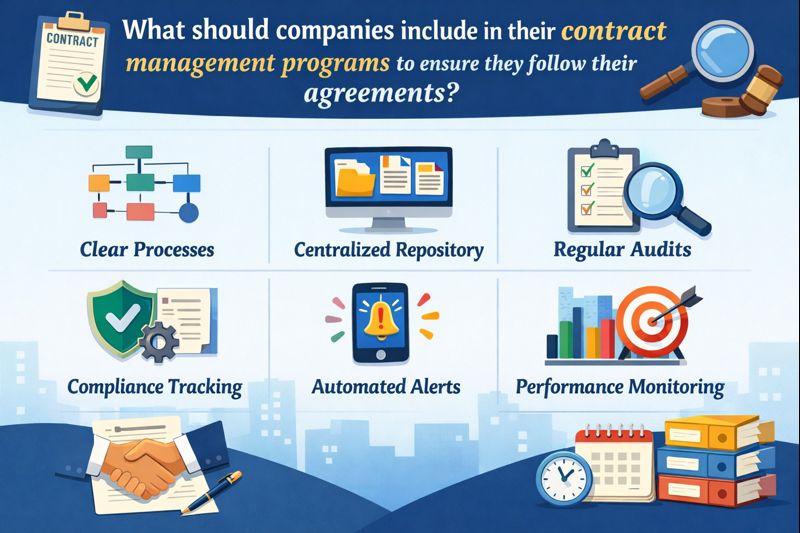
What should companies include in their contract management programs to ensure they follow their agreements?
Efficient contract management programs do not just match governance, processes, technology, and people to make sure they adhere to the contract but also minimize risks, improve performance, and maximize value along the contract life cycle, including the negotiation to renewal and termination.
CORPORATE LAWS
Nandini Ladha
12/25/20254 min read
Introduction
Contracts are the backbone of modern business relationships. They define rights, obligations, risks, and rewards between parties. However, signing a contract does not automatically guarantee compliance with its terms. Many organizations face financial losses, reputational harm, and legal disputes not because contracts are poorly drafted, but because they are poorly managed after execution. To ensure that agreements are consistently followed, companies must implement robust and well-structured contract management programs. A comprehensive contract management program goes beyond document storage. It integrates governance, processes, technology, and people across the entire contract lifecycle. The following sections examine the essential elements companies should include to ensure effective compliance with contractual obligations.
Governance, Liability and Standardized Process
A good contract management program is based on sound governance and accountability provisions. Firms need to clearly identify the role of contract management roles and responsibilities. Both contracts must have a specific contract owner that is responsible for ensuring that the compliance, performance, and deliverables are adhered to. In the absence of proper ownership, duties frequently slide in the cracks between organizations, leading to unintentional attacks. There should also be governance structures to have escalation measures on non-compliance, disagreements, or poor performance. This will keep matters in check and handle them in the right management or legal dimension. The high-value or high-risk contracts that are strategic or regulatory in nature are especially vulnerable to oversight by senior management.
Stable procedures are very important to maintain uniformity and discipline alongside governance. Companies ought to come up with standard procedures for drawing, reviewing, approving, executing, amending, renewing, and terminating contracts. Standardized contract templates and libraries of clauses evade ambiguity and limit the chances of inconsistent and unauthorized terms. When there is standardization, it is also a way of keeping up with internal policies, regulations, and risk management guidelines. Moreover, the procedures of contract management should address the whole contract life. This involves pre-contract due diligence, risk evaluation in the process of negotiations, and after-execution monitoring. A significant number of compliance failures occur due to the fact that organizations perceive the signing of contracts as the final stage of the process but not the initial step of the performance management. The lifecycle approach will make sure that the contractual requirements like payment terms, service levels, reporting requirements, and confidentiality obligations are constantly followed and implemented.
Technology and Risk Management
Technology is important in forcing companies to adhere to their arrangements. Manual contract management has high chances of mistakes, delays, and mismanagement, particularly when the organizations are handling high numbers of contracts. Contract Lifecycle Management (CLM) systems allow centralized places where contracts may be stored, tracked, and managed effectively. Obligation tracking is one of the most significant technological capabilities of a contract management program. Many requirements, milestones, and time points are usually involved in contracts and have to be fulfilled throughout the time. The CLM systems can also identify these obligations, assign the responsibility, and produce automatic notifications of upcoming deadlines, renewals, or expirations. This proactive nature of the case will greatly minimize the chances of default of duties and breach of contract.
The contract management program should also encompass the risk management. Companies should determine high-risk contracts using such parameters as financial risk, regulatory adherence, strategic value, or the reliability of counterparties. These contracts are to be monitored and reviewed on a periodical basis. Performance evaluation and regular compliance audits are used to enable organizations to identify deviations at an early stage and take corrective action. Also, it is essential to have appropriate disciplines of contract modifications. Modifications to the agreements that exist tend to be necessitated by changes in business conditions. Organizations can also use informal understandings or outdated terms without any formalities of the amendment process, which leads to higher legal and compliance risks. The powerful program will make all the changes to be recorded, approved, and communicated to be achieved.
Conclusion
The best contract management systems will not work when the employees are not aware of their contractual duties. Organizational tools are therefore vital elements of any contract management program, such as training and awareness. Training of employees who are engaged in contract negotiations, contract execution, or performance should be undertaken in an effort to introduce them to the fundamental contractual terms, compliance matters, and internal policies. The training should be role-specific and practical, based on real-life contract situations and frequent risks. They should also train employees on how to use the contract management tools and report about the cases of non-compliance. An educated employee base eliminates the need to seek the intervention of legal authorities through reactive means and moderates active compliance.
The other important aspect is performance evaluation. To determine the success of the contract management programs, companies ought to set key performance indicators (KPIs). These can be the rate of compliance, rate of disagreements, financial leakage, rate of renewal, and rate of compliance to service level commitment. The tracking of these indicators enables organizations to determine whether contracts are creating the value they are purported to be able to provide. Lastly, management of contract programs should be able to improve on a continuous basis. Audit and contract performance reviews, disputes, and regulatory developments ought to be taken into consideration as refining processes, updating templates, and improving training. The constant change will keep the program in line with the dynamic business requirements and legal conditions. Companies need to go beyond fragmented and reactive contract management to be in compliance with the agreement. A good contract management program incorporates governance, standardized processes, technology, risk monitoring and employee training. Accountability and a lifecycle approach can be adopted by organizations in order to reduce contractual risks, improve performance, and extract more value out of their contracts. The modern business world is highly sophisticated, and a sound approach to managing contracts is not something that is chosen, but rather a strategic requirement.