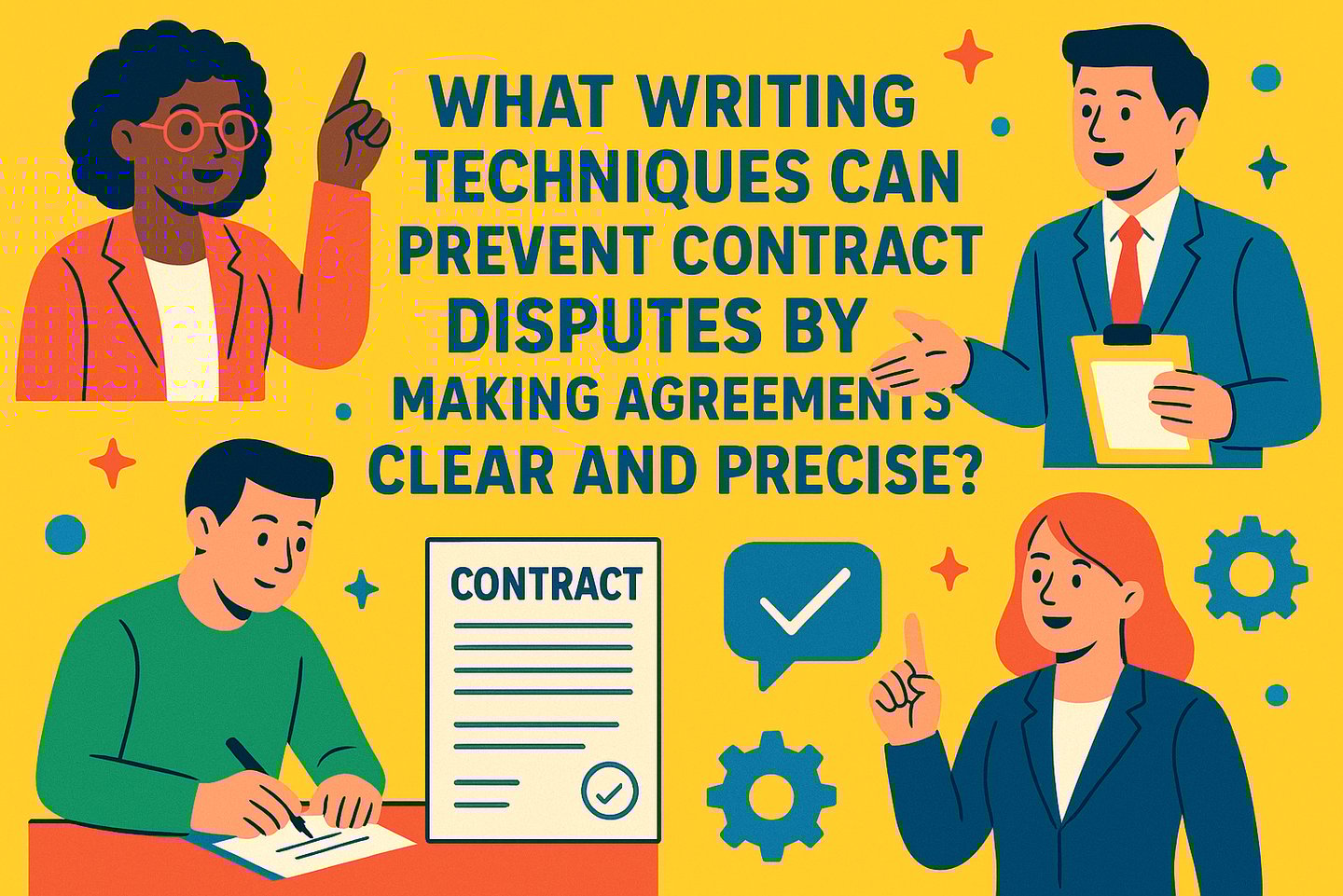
What writing techniques can prevent contract disputes by making agreements clear and precise?
Strategic drafting techniques like plain language, precise definitions, objective metrics, logical structure, and clear risk allocation eliminate ambiguities that fuel contract disputes. Courts now favor contracts reflecting their ordinary commercial meaning. Applying these clarity-focused methods reduces interpretive conflicts, lowers litigation costs, and enhances transactional efficiency and outcomes in modern commercial practice.
CORPORATE LAWS
Rupali Chaurasiya
11/27/20255 min read

Introduction
After twenty-five years of drafting commercial agreements across diverse industries and jurisdictions, I have observed that most contract disputes share a common genesis: preventable ambiguity. The courtrooms where I have testified as an expert witness and the boardrooms where I have negotiated complex transactions have taught me that precision in legal drafting is not merely an academic exercise, it is the foundation upon which successful commercial relationships are built. This article distils the essential writing techniques that can transform contracts from sources of conflict into instruments of clarity and mutual understanding.
The evolution of contract law has consistently rewarded drafters who prioritize clear communication over archaic formalism. Contemporary courts increasingly embrace interpretive approaches that honor plain meaning while acknowledging commercial context. This judicial trend creates both opportunity and responsibility for legal practitioners: the opportunity to draft agreements that courts will enforce as written, and the responsibility to eliminate the ambiguities that invite expensive interpretive disputes.
The Practitioner's Perspective on Contractual Ambiguity
From my experience representing clients in complex commercial litigation, I have learned that ambiguity manifests in patterns that experienced drafters can anticipate and prevent. The most common sources of interpretive conflict are undefined terms that parties assume share universal meaning, temporal references that lack precision, and performance standards that rely on subjective criteria. These seemingly minor drafting oversights generate disproportionate consequences when commercial relationships deteriorate.
Consider a recent technology licensing dispute where the phrase "commercially reasonable efforts" became the centrepiece of a multimillion-dollar litigation. The licensor argued that market conditions justified minimal promotional activities, while the licensee contended that the standard required aggressive marketing comparable to the licensor's own products. This dispute, which consumed eighteen months and substantial legal fees, could have been prevented through specific performance metrics or procedural requirements that quantified the parties' expectations.
The economic reality is stark: ambiguous contracts impose costs on all participants in commercial relationships. Parties must invest in protective measures, maintain larger legal reserves, and dedicate management attention to interpretive disputes that add no commercial value. More fundamentally, uncertainty undermines the planning function that contracts are designed to serve, forcing parties to hedge against interpretive risks rather than focusing on productive commercial activities.
Foundational Techniques for Drafting Clarity
Plain Language as Professional Standard
The plain language movement represents one of the most significant developments in modern legal drafting, and my experience confirms its practical value. Plain language techniques do not sacrifice legal precision; they enhance it by eliminating the cognitive barriers that traditional legal formalism creates. When contracts are written in accessible prose, parties are more likely to understand their obligations, courts are better equipped to enforce contractual terms, and disputes arise less frequently.
The transformation from "notwithstanding any provision contained herein to the contrary" to "despite any other provision in this agreement" exemplifies effective plain language conversion. The revised formulation conveys identical legal meaning while reducing processing time and interpretation errors. Over the course of my practice, I have observed that clients who understand their contracts are more likely to perform their obligations and less likely to claim surprise when disputes arise.
Definitional Precision as Risk Management
Comprehensive definition sections function as insurance policies against interpretive disputes. My approach to definitional drafting has evolved to encompass not only transaction-specific terms but also temporal concepts, procedural requirements, and measurement standards that recur throughout agreements. The capitalization of defined terms serves as a visual signal that alerts readers to specialized usage and prevents inadvertent synonym variation.
The importance of consistent terminology cannot be overstated. Courts interpret linguistic variation as evidence of intentional distinction, meaning that drafters who use synonyms for stylistic reasons may inadvertently create substantive differences in meaning. This principle applies with particular force to obligation-creating language, where precision in modal verbs determines enforceability. The distinction between "shall," "will," and "may" has decided numerous commercial disputes, making modal verb consistency a fundamental drafting discipline.
Quantification Over Qualification
The replacement of subjective modifiers with objective criteria represents perhaps the most direct method for preventing interpretive disputes. Terms such as "reasonable time," "best efforts," and "material adverse change" invite the interpretive conflicts that consume time and resources in commercial relationships. Where subjective standards remain necessary, effective drafters provide contextual guidance through specific examples, measurement criteria, or procedural requirements.
My experience with international commercial transactions has reinforced the importance of temporal precision. Different legal systems and cultural contexts may interpret time-based obligations differently, making specific deadlines, calculation methods, and business day definitions essential for cross-border agreements. The seemingly minor difference between "within five days" and "by the fifth day" has generated substantial litigation in contexts where precision mattered.
Advanced Drafting Strategies
Structural Organization as Communication Tool
Sophisticated contract organization facilitates both negotiation and performance by presenting information in logical, accessible formats. My approach to structural drafting employs numbered subsections, parallel construction in related provisions, and strategic cross-referencing that supports reader comprehension without creating circular dependencies. The use of schedules and exhibits allows complex operational details to be segregated from fundamental risk allocation provisions, enabling focused attention on discrete contractual components.
The strategic placement of definitional material deserves particular attention. While traditional practice locates definitions at the agreement's beginning, I have found that embedding definitions within relevant sections can improve comprehension for provisions that employ specialized terminology. This approach reflects cognitive research suggesting that information is better retained when presented in context rather than as isolated reference material.
Risk Allocation Through Clear Attribution
Explicit risk allocation requires careful attention to both substantive allocation and linguistic expression. Effective risk allocation provisions identify specific contingencies, assign responsibility for risk management, and establish consequences for risk materialization. My experience with indemnification disputes has taught me that successful indemnity clauses require precise specification of triggering events, covered losses, and procedural requirements for claim assertion.
The drafting of limitation of liability provisions demands particular precision due to judicial scrutiny of contractual attempts to limit legal remedies. Courts examine limitation clauses closely and interpret ambiguous language narrowly, making specificity essential for enforceability. Effective limitation clauses employ clear language regarding covered and excluded losses, incorporate appropriate carve-outs for certain types of damages, and establish direct causal relationships between breaches and recoverable losses.
Contemporary Interpretive Framework
Modern contract interpretation reflects judicial appreciation for plain meaning combined with commercial context, creating interpretive frameworks that reward precise drafting. The objective theory of contract interpretation emphasizes reasonable meaning within commercial context, establishing incentives for drafters to anticipate reader expectations and address potential ambiguities explicitly. This approach validates the investment in clarity-focused drafting techniques by making contractual language more predictable in judicial application.
The good faith and fair dealing doctrine, while providing gap-filling function in contractual relationships, operates most effectively when contractual terms provide clear guidance regarding party expectations and performance standards.[vi] Precise drafting therefore serves not only to prevent disputes but also to establish the framework within which implied obligations operate, creating synergy between express contractual terms and background legal principles.
Practical Applications and Lessons
Contemporary commercial practice presents increasing complexity that rewards comprehensive drafting approaches. Technology transactions, for example, require attention to rapidly evolving technical standards, intellectual property ownership, and data protection requirements that traditional commercial agreements may not address adequately. Financial services agreements must navigate regulatory compliance requirements, risk management protocols, and reporting obligations that demand specialized drafting attention.
International commercial contracts present additional challenges requiring attention to translation issues, cultural communication norms, and varying legal interpretive traditions. My experience with cross-border transactions has taught me that effective international drafting requires explicit governing law clauses, comprehensive dispute resolution mechanisms, and communication protocols that account for jurisdictional variations in commercial practice.
Conclusion
The prevention of contract disputes through precise legal drafting represents both professional obligation and commercial necessity. The techniques examined in this article like plain language usage, definitional precision, objective standards, structural organization, and explicit risk allocation provide practitioners with proven tools for enhancing contractual clarity and reducing interpretive conflicts. While no drafting approach eliminates all potential for dispute, systematic application of clarity-focused techniques significantly reduces preventable conflicts while facilitating efficient commercial relationships. The investment in precise drafting yields returns not only in reduced litigation costs but also in enhanced commercial relationships and improved transaction outcomes that benefit all participants in modern commercial practice.